
After a huge total, KL Rahul acknowledges that India lacked sharpness: Complete Match Analysis
 Satyajit Mandal
 India’s commanding total of 358 runs was insufficient to avoid a defeat against South Africa in the second ODI, which was a shocking and disappointing result for Indian cricket fans. The Indian team’s captain for the series, KL Rahul, publicly acknowledged after the game that India “lacked sharpness” despite scoring a huge amount. Discussions concerning India’s competitive advantage, on-field performance, and the areas that require improvement prior to significant upcoming tournaments have been spurred by his candid evaluation.
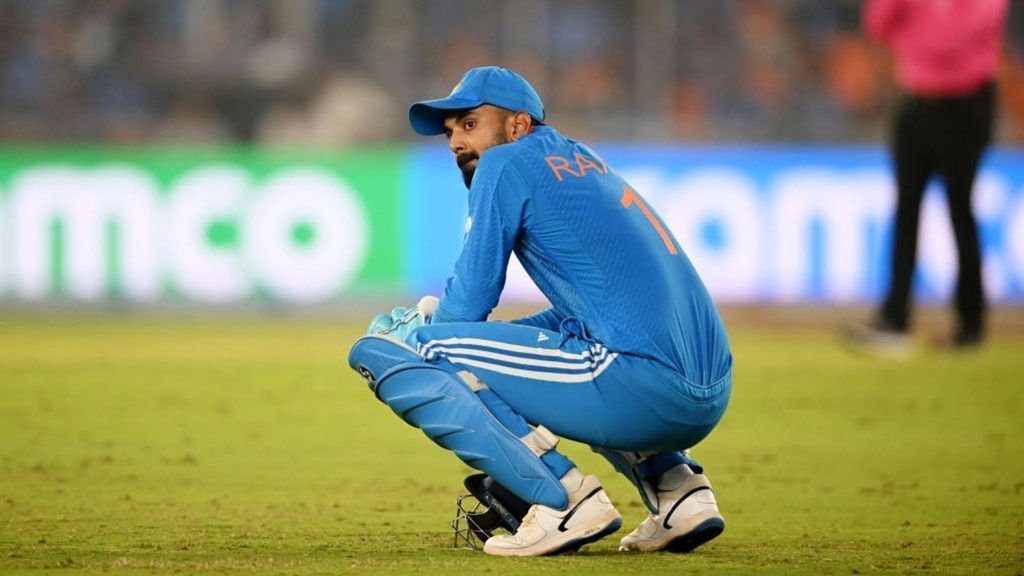
This match offered moments of brilliance from India’s batting lineup, including centuries from Virat Kohli and Ruturaj Gaikwad, but also exposed significant weaknesses in India’s bowling and fielding departments. According to KL Rahul, India lost a match they had initially dominated because of a number of minor errors rather than just one.
A Big Total, Yet a Bigger Disappointment
On most surfaces, India’s score of 358 was more than competitive, and the team was confident going into the second innings. Leading from the front, KL Rahul thought that India should have benefited from the scoreboard pressure. But the circumstances did not live up to their expectations. The bowlers’ effectiveness was diminished by heavy dew, and India’s fielding lacked discipline during critical moments.
KL Rahul maintained that a team with the experience and skill of India ought to have adapted better in spite of all the difficulties. His focus on “sharpness” encompassed both overall match awareness and bowling execution, which is a crucial factor that distinguishes winning teams from losing ones in high-stakes games.
Leadership Under Pressure: How KL Rahul Handled the Situation
Many experts commended KL Rahul for accepting responsibility instead of placing blame, even though some questioned India’s strategies. His calm, reflective, and open leadership style has gained recognition in recent years.
Rahul has demonstrated time and again how important it is to learn from failures. He said in his post-match remarks that every defeat is a chance to reflect and get better. For a team going through a transition, this mindset is crucial, particularly as younger players become part of the team.
What India Must Fix Before the Next Match
- India has to practice additional strategies for wet weather, such as: use slower balls and more cutters bowling in more straight lines safeguarding border regions.
- Communication, preparation, and fitness need to be improved. Small lapses cost big matches.
- KL Field placements could have been more proactive, Rahul implied. In the upcoming game, expect changes.
- It is essential to pick wickets between overs 15 and 40. Rahul stressed that even large totals become chaseable in the absence of breakthroughs.
A Loss That Could Become a Turning Point
Both the team and the supporters found the second ODI loss to be difficult, but KL Rahul’s frank evaluation gives optimism. India is well-positioned to recover because to his leadership, the talent of young players like Gaikwad, and the skill of seasoned players like Kohli.
India should use this loss as a teaching opportunity if they can improve the areas Rahul pointed out, particularly execution precision. With more games to come, KL Rahul’s emphasis on responsibility and ongoing development may be just what India needs to reclaim its supremacy.


Друзья — кто реально разбирается,
зачем нужны входящие ссылки?
Начал копать тему SEO и понял — бэки — это как кислород для сайта.
Брал ссылки вручную и через агрегаторы, но цены кусаются.
Нашёл одну фишку, после которой пошёл рост.
Не буду спойлерить, но вот
ссылка — сюда обратные ссылки .
Есть подробная инструкция и реальные
кейсы.
Результаты приятно удивили — особенно по конкурентным запросам.
Не теряйте время на спам и дешёвые
ссылки — посмотрите этот вариант.
Пока акция действует — лучше не тянуть https://hoodpedia.com/index.php/%C3%90%C2%A1%C3%90%C2%BE%C3%90%C2%B7%C3%90%C2%B4%C3%90%C2%B0%C3%90%C2%BD%C3%90%C2%B8%C3%90%C2%B5_%C3%90%C2%A1%C3%91%C3%91%E2%80%B9%C3%90%C2%BB%C3%90%C2%BE%C3%90%C2%BA_-_%C3%90%C5%B8%C3%90%C2%BB%C3%91%C5%BD%C3%91%C3%91%E2%80%B9_%C3%90%C3%A2%E2%82%AC%E2%84%A2%C3%90%C2%B5%C3%90%C2%B1-%C3%91%E2%82%AC%C3%91%E2%80%B9%C3%90%C2%BD%C3%90%C2%BA%C3%90%C2%B0
Greetings from Los angeles! I’m bored to death at work so I decided to browse your website
on my iphone during lunch break. I really like the knowledge you present here
and can’t wait to take a look when I get home.
I’m shocked at how fast your blog loaded on my mobile ..
I’m not even using WIFI, just 3G .. Anyhow, great site! https://hawaaworld.com/